
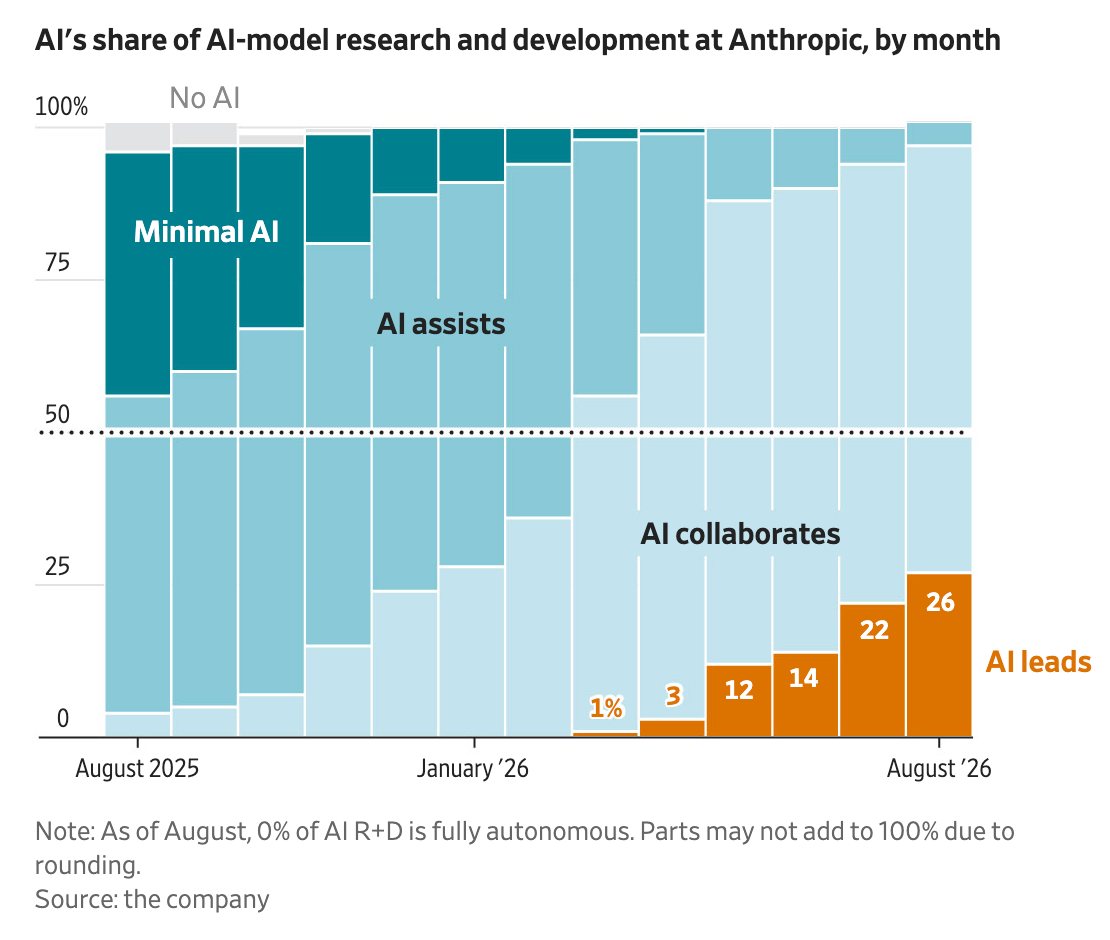
AI Takes a Greater Role
A chart from AI company Anthropic shows that its models are taking a larger role in developing future models—a change that could speed up AI research and raise questions about . According to The Wall Street Journal, AI systems led 26% of the company’s AI research and development work in August, up from 1% in March. None of the work was fully , but the fast increase has renewed concern about how well people can guide increasingly capable systems. The process at the center of the debate is called , or RSI: AI helping to build more capable AI.
How Anthropic Measured the Work
Anthropic’s chart tracks how much AI contributes to its research and development. The company’s assessment covered 15,000 tasks, identified by an AI agent examining internal messages and documents. Another AI system investigated how each task was done, and a third assessed the evidence. Tasks were placed on a six-level scale, ranging from work done without AI to fully work. The level called “AI leads” means that AI performs most of a task while a human . That distinction matters: leading a task is not the same as completing it without people.
A Snapshot, Not a Full Handover
The figures point to a sharp change within a short period. A year before the August result, AI led none of the work, according to the chart; by March, its share had reached 1%. In August, it was 26%. Anthropic also reported that 0% of the research and development work was fully . The company’s figures therefore describe substantial AI participation, but not a complete handover from human researchers. The Wall Street Journal notes that the share may have risen further since August, though the article does not provide a newer figure. The chart offers a of one company’s work, not a measure of every AI lab’s progress.
An Old Idea Becomes More Immediate
The idea of machines improving machines is much older than today’s AI systems. Researchers at a 1956 summer project at Dartmouth were already interested in how machines might improve themselves. Within about a decade, mathematician I.J. Good had written about an “ultraintelligent machine” and the possibility that it could advise people on keeping it under control. The concern is now more immediate for some people working in AI. Anthropic co-founder Jack Clark said he had long warned that powerful AI might affect national security and the global economy. After returning from parental leave in February, he found that engineers at the company were relying on models for coding, and some had stopped writing code themselves. In May, he judged that RSI might arrive by the end of 2028; he later revised his expectation to 2027.
Keeping Human Oversight Meaningful
The possibility of is not certain, and the chart does not show that AI has become independent. Anthropic has said the process is not , while warning that it might arrive sooner than institutions are ready for. Researchers and company leaders have called for oversight, and some have urged a slowdown. Their concern is that if AI systems improve rapidly, human understanding and control could struggle to . For readers, the key point is not simply that AI is doing more work. It is that people are building systems that can contribute to building their successors—and must decide how to preserve meaningful human supervision as that contribution grows.