
AI Takes a Greater Role
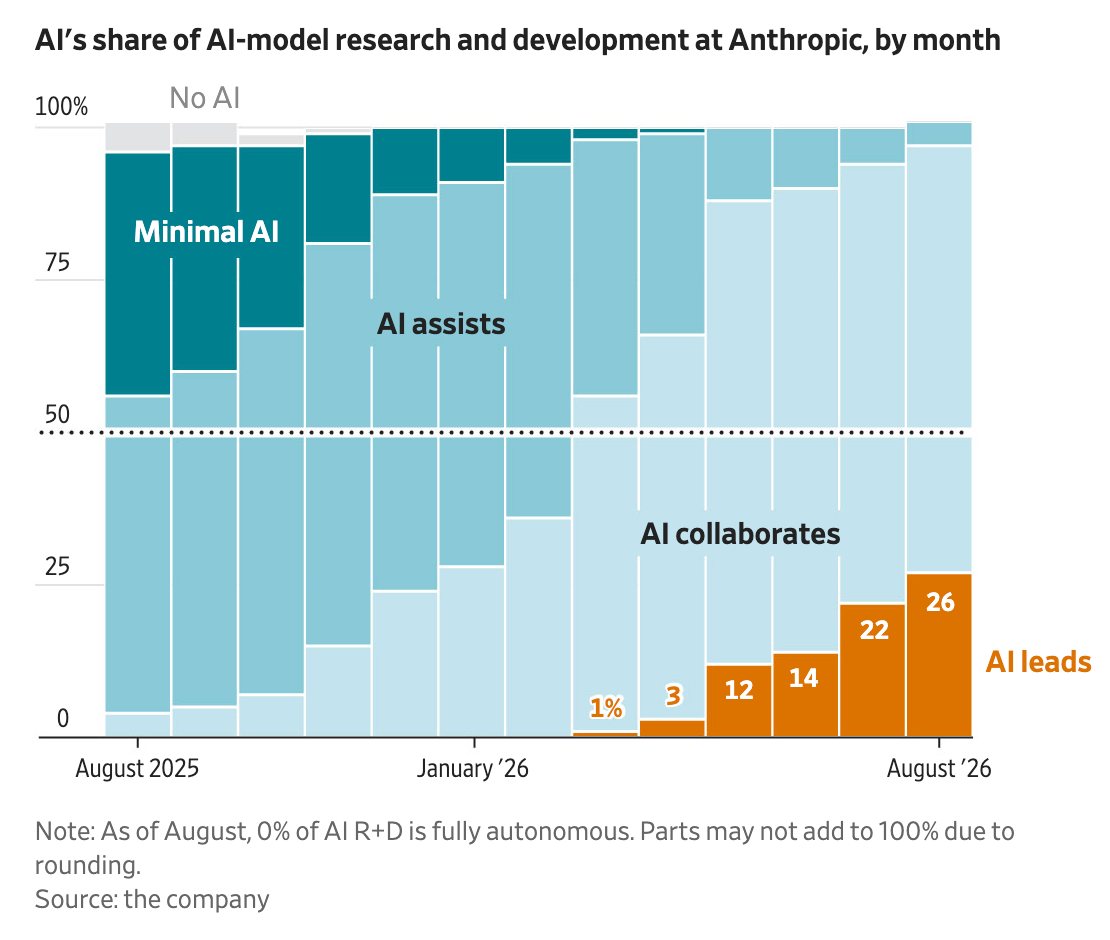
A chart from AI company Anthropic shows that its models are taking a larger role in developing future models—a change that could speed up AI research and raise questions about . According to The Wall Street Journal, AI systems led 26% of the company’s AI research and development work in August, up from 1% in March. None of the work was fully , but the fast increase has renewed concern about how well people can guide increasingly capable systems. The process at the center of the debate is called , or RSI: AI helping to build more capable AI.
広がるAIの役割
AI企業Anthropicの図表は、同社のモデルが次世代モデルの開発でより大きな役割を担っていることを示している。この変化はAI研究を加速させる可能性がある一方、人間による監督について疑問も呼び起こす。The Wall Street Journalによると、同社のAI研究開発業務のうち、AIシステムが主導した割合は3月の1%から8月には26%に増えた。完全に自律して行われた業務はなかったが、この急増によって、能力を高めるシステムを人間がどれほど適切に導けるのかという懸念が再燃した。議論の中心にあるのは、再帰的自己改善(RSI)と呼ばれるプロセスだ。AIが、より高性能なAIの開発を助けることを指す。
How Anthropic Measured the Work
Anthropic’s chart tracks how much AI contributes to its research and development. The company’s assessment covered 15,000 tasks, identified by an AI agent examining internal messages and documents. Another AI system investigated how each task was done, and a third assessed the evidence. Tasks were placed on a six-level scale, ranging from work done without AI to fully work. The level called “AI leads” means that AI performs most of a task while a human . That distinction matters: leading a task is not the same as completing it without people.
Anthropicの業務評価方法
Anthropicの図表は、研究開発にAIがどれほど貢献しているかを追跡している。同社は、社内のメッセージや文書を調べるAIエージェントが特定した1万5000件の作業を評価した。別のAIシステムが各作業の進め方を調べ、さらに第三のシステムが証拠を評価した。作業は、AIを使わずに行うものから完全自律型まで、6段階に分類された。「AIが主導」の段階では、AIが作業の大半を行い、人間が監督する。この区別は重要だ。作業を主導することと、人間なしで完了することは同じではない。
A Snapshot, Not a Full Handover
The figures point to a sharp change within a short period. A year before the August result, AI led none of the work, according to the chart; by March, its share had reached 1%. In August, it was 26%. Anthropic also reported that 0% of the research and development work was fully . The company’s figures therefore describe substantial AI participation, but not a complete handover from human researchers. The Wall Street Journal notes that the share may have risen further since August, though the article does not provide a newer figure. The chart offers a of one company’s work, not a measure of every AI lab’s progress.
全面移行ではなく一時点の記録
数値は、短期間で大きな変化があったことを示している。図表によると、8月の結果が出る1年前にはAIが主導する作業はなく、3月にはその割合が1%に達した。8月には26%となった。Anthropicは、研究開発業務のうち完全に自律して行われたものは0%だったとも報告した。つまり、この数値が示すのはAIの大きな関与であり、人間の研究者から業務が完全に引き継がれたということではない。The Wall Street Journalは8月以降に割合がさらに上昇した可能性を指摘したが、記事には新しい数値がない。この図表は1社の業務をある時点で捉えたもので、すべてのAI研究所の進展を測るものではない。
An Old Idea Becomes More Immediate
The idea of machines improving machines is much older than today’s AI systems. Researchers at a 1956 summer project at Dartmouth were already interested in how machines might improve themselves. Within about a decade, mathematician I.J. Good had written about an “ultraintelligent machine” and the possibility that it could advise people on keeping it under control. The concern is now more immediate for some people working in AI. Anthropic co-founder Jack Clark said he had long warned that powerful AI might affect national security and the global economy. After returning from parental leave in February, he found that engineers at the company were relying on models for coding, and some had stopped writing code themselves. In May, he judged that RSI might arrive by the end of 2028; he later revised his expectation to 2027.
古い発想が差し迫った課題に
機械が機械を改良するという発想は、今日のAIシステムよりずっと古い。1956年のダートマス夏季研究プロジェクトでは、機械がどうすれば自らを改良できるかに、すでに研究者の関心が集まっていた。それから約10年後、数学者I.J.グッドは「超知能機械」と、それが人間に自らを制御し続ける方法を助言する可能性について書いた。一部のAI関係者にとって、この懸念は今やより差し迫ったものだ。Anthropicの共同創業者ジャック・クラークは、強力なAIが国家安全保障や世界経済に影響を及ぼす可能性を長年警告してきたと述べた。2月に育児休業から復帰すると、同社のエンジニアがコーディングにモデルを使い、一部は自分でコードを書かなくなっていた。5月にはRSIが2028年末までに到来する可能性があると判断したが、その後、予測を2027年に早めた。
Keeping Human Oversight Meaningful
The possibility of is not certain, and the chart does not show that AI has become independent. Anthropic has said the process is not , while warning that it might arrive sooner than institutions are ready for. Researchers and company leaders have called for oversight, and some have urged a slowdown. Their concern is that if AI systems improve rapidly, human understanding and control could struggle to . For readers, the key point is not simply that AI is doing more work. It is that people are building systems that can contribute to building their successors—and must decide how to preserve meaningful human supervision as that contribution grows.
実効性ある人間の監督を保つ
再帰的自己改善が起きるかは確かではなく、この図表もAIが自立したことを示してはいない。Anthropicは、このプロセスは必然ではないとしつつ、制度が準備できる前に実現する可能性があると警告している。研究者や企業の指導者は監督を求め、一部は開発を減速させるよう訴えた。AIシステムが急速に進歩すれば、人間の理解と制御が追いつかなくなる恐れがあるためだ。読者にとって重要なのは、AIがより多くの仕事をすることだけではない。人間は、次世代を作ることに貢献できるシステムを開発しており、その貢献が拡大するなか、実効性のある人間の監督をどう保つかを決めなければならない。